
Joyce (Fangyu) Zhang
Chapter 6 Live Concerts and the Pathway TowardVentral Vagal Regulation
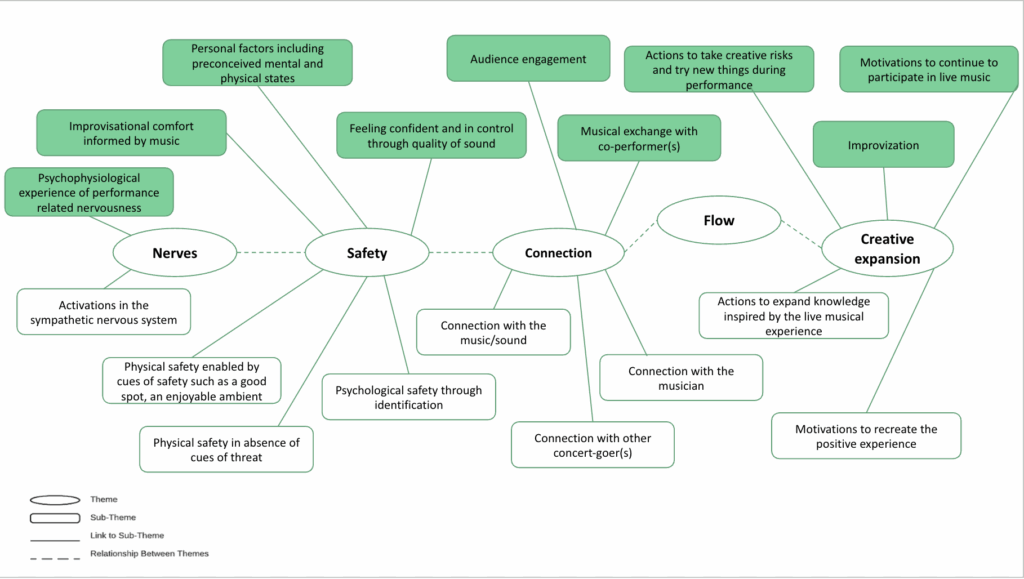
Attached: Thematic Map Illustrating Psychophysical Experiences of Musicians (Green) and Audience Participants
Joyce-Fangyu Zhang is an interdisciplinary researcher and practitioner working at the
intersection of art, psychology, and healing. She approaches artistic expression as an
accessible entry point into the personal and collective psyche, with the conviction that aesthetic
experiences can reattune individuals and communities to the underlying patterns and natural
rhythms that shape the more-than-human world.
She holds an undergraduate degree in Classics and Psychoanalysis from Colorado College and
a Master of Science in Business Psychology. Her research explores how encounters with
literature, music, and visual art open pathways into deeper strata of consciousness and
emotional life.
Her scholarly trajectory began with a thesis on the Homeric Hymn to Hermes, using a
psychoanalytic lens to show how mythic narratives encode enduring motifs of psychological
development. This early work established her commitment of treating artistic texts as dynamic
encounters with the structures of human (un)consciousness. She extended this line of inquiry in
her graduate research, conducting a qualitative study of live concerts that mapped the
psychological terrain experienced by both musicians and audiences.
This chapter stems from her graduate thesis titled What makes live music special? A qualitative
exploration of the experiences of live music participants in a digitalized world.
She is currently based in Berlin.
Attached: Thematic Map Illustrating Psychophysical Experiences of Musicians (Green) and
Audience Participants
Educational Use & Copyright Disclaimer
This chapter and its accompanying website reference audio and video examples of live musical performance exclusively for educational, analytical, and scholarly use in support of discussions on Polyvagal Theory, ventral vagal regulation, co-regulation, trauma recovery, and music psychology.
No copyrighted music, videos, or performance recordings are hosted, duplicated, or redistributed. All embedded or referenced materials link only to official sources controlled by the copyright owners (e.g., YouTube artist channels, orchestras, concert halls, music therapy organizations).
All copyrights and related rights remain the exclusive property of their respective owners.
The authors’ use of these references qualifies as fair use for scholarly commentary, teaching, criticism, and research under U.S. copyright law.
If any rights holder requests removal of a link or reference, it will be promptly honored.